
Dear Reader,
On a breezy afternoon in May, I sat down at a park for a conversation with Gail Yamamoto Seymour, a lifelong environmental scientist in Sonoma County and third generation Japanese American.
I first met Gail at a screening of our docuseries, Climate California, and she got in touch with me a few months later by replying to this newsletter. I learned she was retired from a decades-long career in government conservation work, and now dedicates her time to environmental justice organizing with local chapters of the NAACP and Japanese American Citizens League. We’ve since kept in touch and even worked together on an event series with NorCal Public Media back in April.
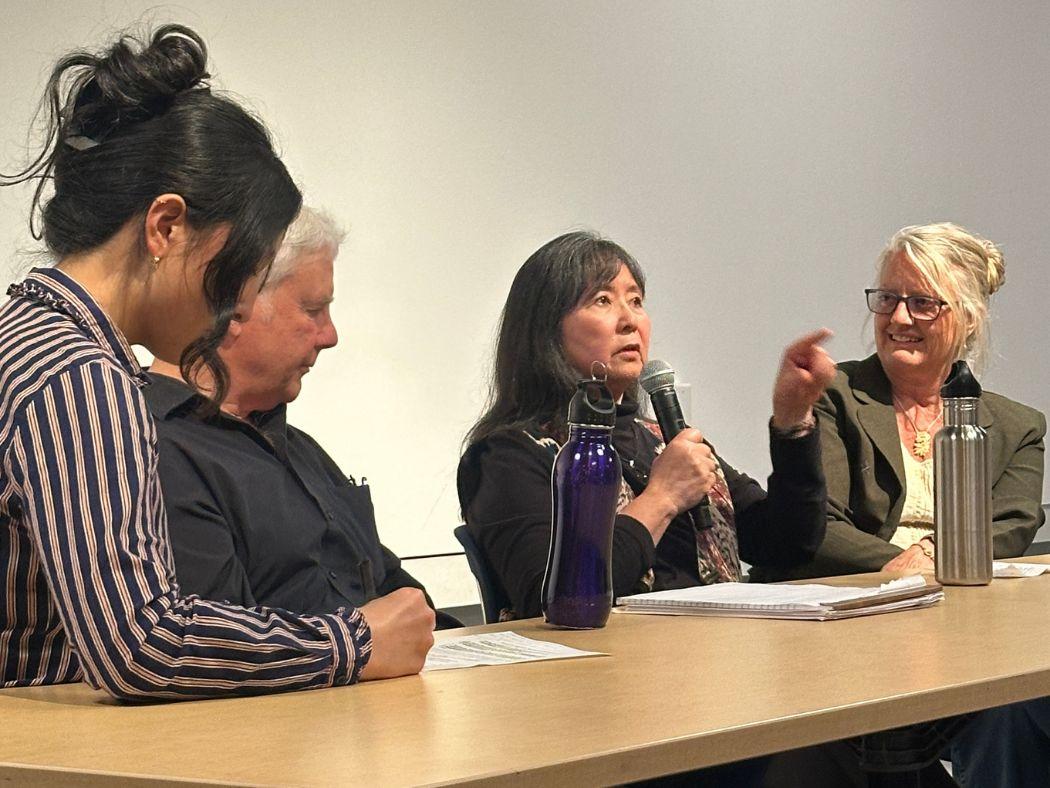 Gail and I speaking together at an event.
At Roberts Lake, Gail stops to coo at a family of nearby geese at, moving her sunglasses up over her long black and grey hair. We plop down at an empty picnic table and I unload my audio recorder, headphones, and notebook – everything I’ll need to document our conversation.
“I've always been an animal lover since I was very, very young,” she tells me. “Both domestic and wild animals, including insects and all the way down the food chain.”
I think about how relatable that statement is to me, and how I’ve really come to like and admire Gail. Outwardly, she’s personable, funny, and charismatic – but something about her eyes and the way she speaks reveals a sharp tenacity, acquired over years of fighting hard environmental battles. And it's those experiences that I’m eager to unpack with her today.
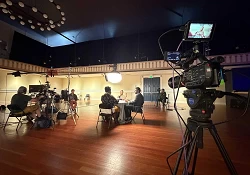
Some context. In just over a week, the United States will be marking the 250th anniversary of American Independence – and for the past year, we at NorCal Public Media have been working on a related project. Generations: California @ 250 is our new TV docuseries exploring local history through intergenerational stories within different communities. Each episode features a roundtable conversation between three generations reflecting on our past, present, and future. In the spirit of that series, I decided I would capture my conversation with Gail for this month’s newsletter.
As I suspected, she and I have a lot in common. We’re both passionate about and have dedicated our careers to environmental work. We’re both Asian American women in historically white, male dominated professions. We both grew up in culturally conservative homes, where being outspoken environmentalists has kind of made us into black sheep.
“My father said to me, ‘How did you get to be so weird? I didn’t raise you to be weird,’” Gail recounts with a laugh. And I laugh too – because I have definitely heard that before in my own life.
But Gail came up in a different and arguably much more challenging time for folks like us. I ask about her experience working in conservation in the 70s as a woman of color.
“I was treated so horribly. … I mean, I was called the most horrible names you can imagine,” Gail tells me plainly. “There’s a lot of microaggressions still, but back then it was macro. You know, being looked at as insignificant.”
“How did you not get discouraged and just, bogged down with it?” I ask.
“I hate to say this,” Gail pauses. “I don't know.” She recalls facing several instances of blatant racism and misogyny, from peers and supervisors alike. But, to her dismay today, she never spoke out.
Gail wonders if her tolerance has something to do with her family’s experience during the World War II internments. “My grandmother's from Japan. Very reserved, didn't say anything even when they were kicked out of their homes – that whole generation’s silent Americans,” she says. “But that generational trauma, I think it might get passed down.”
It’s no wonder that for Gail, there’s an obvious link between the oppression of humans and of nature.
“When it comes to the environment and wildlife, and people who are marginalized and underserved, it's the justice thing that gets to me,” she says. “I think that’s at the core.”
This intersection that Gail has instinctively understood since childhood has slowly made its way into the mainstream environmental movement over the last couple of decades. More and more, the public is recognizing that climate change is inherently a justice issue – and that includes justice for people, too.
“People don't realize that they're the ones that are going to suffer first and the most during a drought, during a wildfire, during flooding,” says Gail, a firm believer that making this connection clear is a key part of getting people to act.
“It's got to hit directly to that person. I'm not saying that they’re selfish people, but most people will do something when it's worrisome to them, or there's a value in it for them,” she tells me.
Gail’s touching on a big challenge in the environmental movement, which has historically focused on making asks of the public rather than offering something of value. Whether it’s buying less single-use plastics or donating to save the polar bears, “protecting the environment” at a personal expense is a tough sell for everyday working people.
Being conscious about this uphill narrative battle is one of the ways Gail has made inroads with communities that haven’t always welcomed eco-warriors.
During her time with the California Department of Fish and Wildlife, Gail was part of restoration efforts in Salmon Creek Watershed – whose regional stakeholders included lifelong agriculturalists like Joe Pozzi, a fourth-generation rancher. Coincidentally, Joe is a central voice in our very first episode of Generations, and the crew and I share fond memories of filming with him on his ranch in Valley Ford.
Gail reveals she and Joe have a tumultuous history. “We were adversarial,” she says. “Really bad.”
This comes as a surprise to me. During filming, Joe was outspoken about his conservation advocacy and his deep belief that sustainable agriculture was not only better for local ecosystems, but for his business.
But Gail recalls that at the time, she was considering applying for watershed restoration grant funding from another regulatory agency – which would, in turn, attract scrutiny and enforcement around the surrounding farmland. And while Joe has always genuinely been passionate about stewardship, he also knew that getting regulatory agencies involved would make his already challenging work that much harder.
Gail’s response?
“I backed off,” she says. “I just thought, there were other ways for us to improve the watershed and water quality.”
It proved to be a smart move.
By showing she could be on their side, Gail was eventually able to build trust with local agriculturalists like Joe – and together, they were far more effective at improving the health of the watershed. Gail quickly saw that establishing environmental protections is a nuanced conversation, best had with the community whose livelihoods are on the line, rather than imposed on them from above.
“I think anybody who goes in and says, ‘You need to be doing everything possible to protect water quality … in spite of your livelihood’ – that's just the wrong approach.”
And just like with Gail’s nuanced understanding of environmental justice, it seems like the larger movement today is finally catching on.
Many recent organizing and messaging campaigns have made a big push for coalition-building, especially across the political aisle. From conservatives to oil workers to evangelical Christians, the climate movement is expanding its target audience. (We cover all three in Episode 9 of Climate California, and on its companion podcast A Fighting Chance) In my view, these kinds of narrative shifts demonstrate great progress in our approach to public communication – a cultural win.
But it comes in the face of so much incredible loss for our planet. In fact, we’re continuing extracting, consuming, and emitting more than ever before, with little sign of reeling things in. And yet, somehow, our current political climate can make it easy to feel like these are the least of our collective concerns.
“Can I ask you a question?” I venture. Gail tilts her head. “Do you think that there’s hope for climate change?”
This is the question I grapple with daily. Hope, solutions, and joy are centerpieces in the modern climate conversation – an effective counter narrative to the doom and gloom approach of past decades. But finding grounds for optimism isn’t always easy.
“Do you feel like it’s a solvable problem?” I continue. “It’s a solvable problem, but do you think we’re going to solve it?”
Gail pauses for a moment, but then simply answers: “No.”
I give a slow nod as this sinks in. Maybe not the answer I was hoping for, but knowing Gail, it also doesn’t come as a surprise. She’s not one to sugarcoat.
“The harm’s been done,” she says. “Even if we stopped all greenhouse gas emissions right now and everybody did the right thing, what we've done to this planet since the beginning of the Industrial Revolution in the 1850s – we can't undo that.”
And somehow, it’s oddly refreshing to hear Gail – a parent, and a grandmother to five little ones – say that she doesn’t necessarily feel hopeful about the future of climate change.
But she still does the work. Between spearheading environmental working groups, attending NAACP and JACL meetings, caregiving full time for her 101-year-old mother, and being an active grandparent, Gail might be busier than I am.
“Anything you do that would help to offset climate change, is also offsetting environmental degradation right before your eyes,” she tells me.
Gail explains that while no individual can “solve” climate change, there are many things we can do to tangibly improve our local environment and the wellbeing of the people that depend on it – an inherently worthy cause. And importantly, climate is not an all-or-nothing kind of fight. So many lives, communities, and species hang in the balance between climate utopia and catastrophe, which we can only continue navigating to the best of our abilities.
It’s a very practical approach that helps ground my outlook.
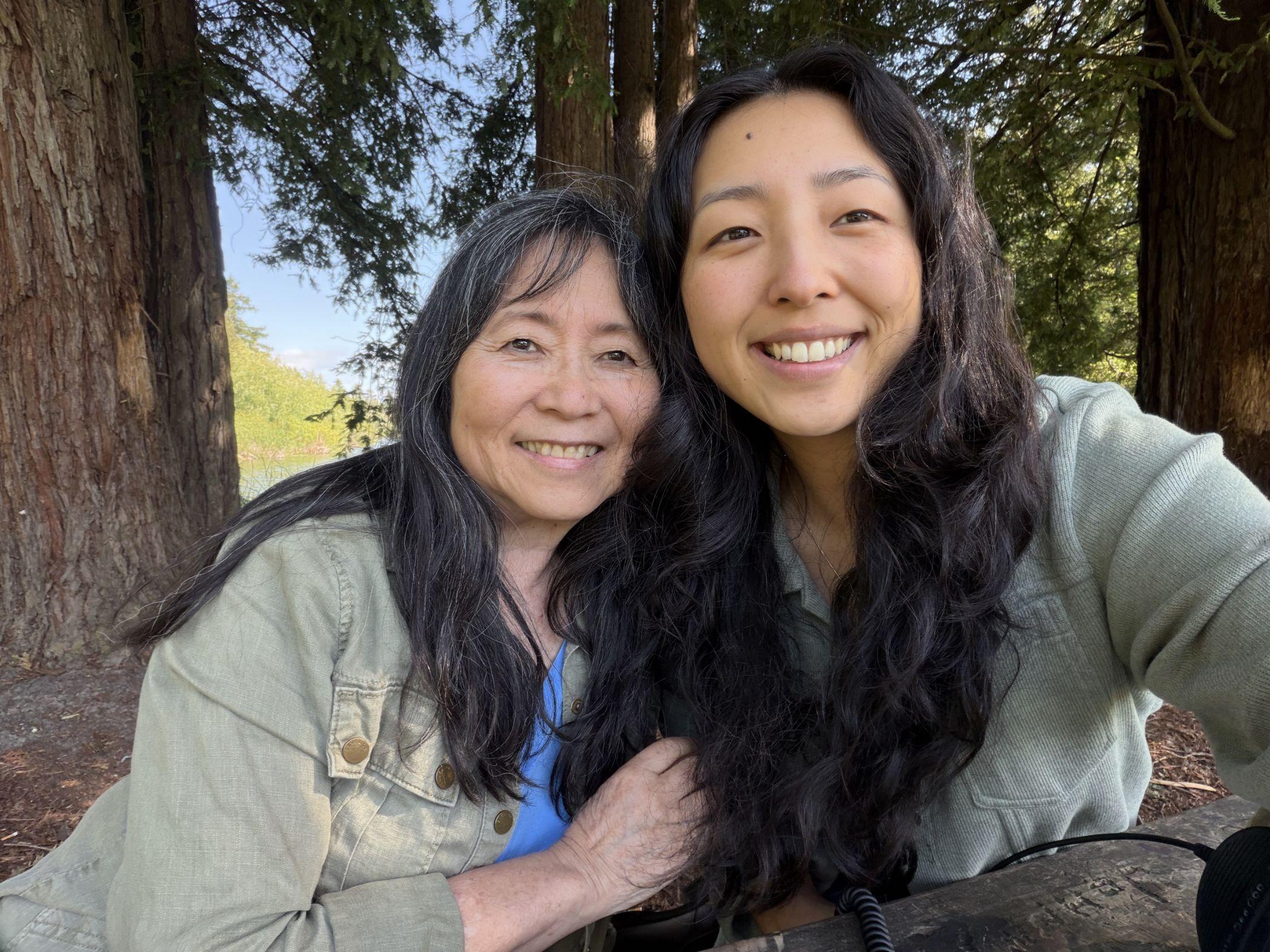 Gail and I snap a selfie together.
Gail and I have now been chatting for about twice as long as I had planned, but neither of us feel quite ready to end the conversation. So, we agree to pause here for now and meet again sometime in the future. To wrap up, I ask Gail if she has any advice for a young person like myself, trying to make change.
“I think that we have to be pragmatic and not idealistic,” she says. “In the 70s, can you imagine how idealistic we were? Like, love and peace, and we're going to save the environment and the wildlife.”
Gail looks back on this idealism as largely rooted in privilege, underlined by a “holier-than-thou” approach to environmentalism that can be alienating for many.
“It's cool to go out and be barefoot, live on the land, be hippies, because you've had it all,” she explains. “But then there's people who haven't had anything, and maybe they want the stuff that you've had the privilege of having. So why would they want to even consider giving that up or not even having it in their lives?”
In short? Check your privilege. Be a realist. Truly listen to the people you’re trying to reach. And at 25, I have a lot to learn from Gail’s lifelong perseverance in this work.
As always, my hope with this newsletter is to create space for an exploration of ideas, knowledge, and meaning-making together. Please reach out with your thoughts on this edition of Our Planet, Our Voice. It’s as easy as replying directly to this email, and I would love to hear from you! This month, my question for you is: What work is taking place in your community that serves both people and the planet?
And if you’re interested in watching Generations, you can catch it live on KRCB and KPJK TV, or stream it on PBS Passport. Plus, on July 1st we’ll be holding a screening at Rialto Cinemas in Sebastopol, followed by a panel conversation with guests from the show. I hope to see you there!
All my best,
Hannah