
 Live Radio
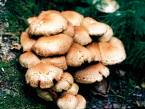
Fungi are the oldest living things on land, and among their estimated two million varieties, they may hold many yet-to-be-discovered medicinal uses and other benefits.
{mp3remote}http://media.krcb.org/audio/nbr/6-229-09.mp3{/mp3remote} Paul Stamets, founder and president of Fungi Perfecti , has written six books on mushroom cultivation including Growing Gourmet and Medicinal Mushrooms and The Mushroom Cultivator. In this audio lip, he offers a short history of fungi:

As a dedicated mycologist for more than 30 years, Stamets has discovered or identified four new species of mushroom. Here, he talks about how it feels to make such a discovery.
{mp3remote}http://media.krcb.org/audio/nbr/discover.mp3{/mp3remote}
 Among the many fungal processes that hold great promise for addressing human needs, Stamets points to one that could herald important changes in ethanol production.
We tend to think of history as a record of human activity, but a natural landscape also has a history all it's own, which is what is studied in the new field called historic ecology.
{mp3remote}http://media.krcb.org/audio/nbr/5-28-09.mp3{/mp3remote}
 The San Francisco Estuary Institute's study of the Napa River ecosystem was a project that brought together a wide alliance of stakeholders, notes Robin Grossinger (right), and developed information that could be used for multiple purposes.


SSS Professor Matt James returned to the Galapagos Islands earlier this year to recreate the 1905-06 collecting expedition mounted by the San Francisco Academy of Sciences. One of their main goals, even then, was to preserve evidence of the endangered Galapagos tortoise, which, he explains, had been hunted to near extinction by 19th century sea-farers.


Charles Darwin's enduring reputation rests on his theory of natural selection, but prior to that, his greater interest was geology, which he exercised extensively during the early years of the voyage of the Beagle, which arrived at the Galapagos (below) late in its five-year global mapping and collecting expedition.
{mp3remote}http://media.krcb.org/audio/nbr/biology.mp3{/mp3remote}


Darwin's finches may be the best-known exemplars of divergent natural selection in the Galapagos islands, but SSU professor Matt James reports that finding was nearly missed, due to Darwin's own sloppy sample-gathering.
{mp3remote}http://media.krcb.org/audio/nbr/finches.mp3{/mp3remote}

The Sonoma County non-profit Land Paths, founded a dozen years ago to help connect urban residents to the natural world around them, is finding that goal taking them in some unexpected new directions.
{mp3remote}http://media.krcb.org/audio/nbr/5-14-09.mp3{/mp3remote}
Landpaths' mission is "to foster a love of the land in Sonoma County," a broad goal that underlies their many day-to-day activities. The common thread among them, observes Executive Director Craig Anderson, is a shared appreciation for the natural world, and a willingness to listen.
{mp3remote}http://media.krcb.org/audio/nbr/senseofplace.mp3{/mp3remote}LandPaths offers both a busy list of hikes and other activities , and a wealth of volunteer opportunities such as creating new hiking trails (below).
 They also have a lovely online photo gallery of scenes from Sonoma County's outdoors.
- Green-Collar Jobs
- Wave Power
- John Muir
- Bees vs. Mandarins
- GMO Mystery
- Geo Tourism
- Farm Succession
- Drought
- Conservation Corps
- Water Agency Governance
- Coho release
- Conservation Strategy Fund
- Heritage Turkeys
- Rare Fruit
- Garden Allies
- Biomimicry
- Sonoma County's Climate Action Plan
- Solar Sonoma County
- Ants
- "Soil, Not Oil"
- Aqua EcoTourism
- California's Raw Milk Law
- State of the River
Northern California
Public Media
Newsletter
Get the latest updates on programs and events.
