
 Live Radio
 Now that California has officially designated a series of offshore coastal areas as Marine Protected Areas, the state needs to monitor them. Lori Abbot has this report on how that's being done.
At right, an underwater fish survey in progress. Photo courtesy of Reef Check California.
by Aubrey White
 Lately, I’ve seen the familiar signs of back-to-school. The school bus noisily pulls away from my neighbor’s house before the sun has fully risen. The neighborhood kids are inside a bit earlier in the evening (probably to finish that pesky homework), and I see throngs of students walk down the street with heavy backpacks slung low over their shoulders. But there are a few new signs in my neighborhood that school is back in session; kids with dirty jeans, mud stained at the knees from time spent in the school garden.
Interest in school gardens in
The Creating and Sustaining Your School Garden workshops teach the nuts and bolts of starting a garden, but also provide trainees with curriculum designed to bring many state-mandated education requirements into the garden. Between 2012 and 2014, the workshops aim to train approximately 700 school educators from throughout
“School gardens really should be regionally mentored,” says Carol Hillhouse, director of the UC Davis Children’s Garden Program. “
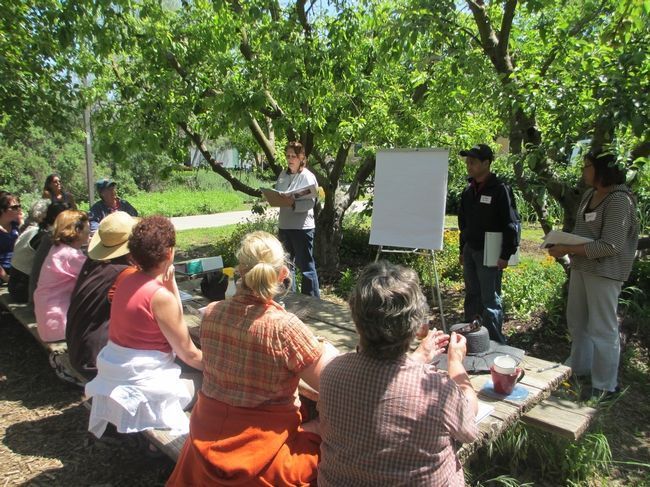 Between 2007 and 2008, the workshops trained 180 trainers, who went on to train an additional 664 people in the practice of starting a school garden. The participants in those workshops represented nearly 300 schools, with a school population of 93,879. The sustained level of interest in these workshops and in school gardens in general over the years has been impressive.
School budget cuts, threats to school programs and teacher salaries are a grim reality in
Still, gardens are not yet institutionalized within school budgets, and so their success depends on staff members, community and parent volunteers. Hillhouse advocates for gardens becoming more than expendable extras within schools.
“There’s a real power in gardening. Whenever you’re gardening, people want to see what’s happening and get their hands dirty. They get excited and want to start gardens in their own schools; this is a tangible way they can make their schools a better place," she said. “If we help hone that attitude from ‘we can put a garden here’ to ‘we can put a garden here, and it can help support our science curriculum, and it can help kids understand what to eat in the cafeteria, and it can even produce roses that we can put on the principals desk,’ then we have a viable program. Not just a garden, but a program that enriches a school in many ways”
Creating and Sustaining Your School Garden workshops along with workshops in other topics will be offered several more times around the state between now and June of 2014. Visit the UC Davis Children’s Garden Program website for information on dates and locations as they are scheduled and links to workshop registration.
 Sonoma Compost was one of the three winners of Green America's first quarterly "People & Planet" award, which recognizes America's best green, small businesses.The others were: Green Kid Crafts of Anchorage, Alaska, and Raleigh City Farm from Raleigh, North Carolina. Each of three winners, who were selected by the public during a month-long open voting period at Green America's website, will receive $5,000.
 Sonoma Compost Company (SCC) partners with local schools, non-profits and local government to provide education and resources that further the goals of sustainable agriculture. In 2011, SCC donated over 830 cubic yards of compost to about 150 school and community gardens. In addition, SCC conducts facility tours for school and provides on-and off-site public education to over 1500 individuals. Furthermore, it attends community fairs and festivals promoting sustainable agriculture and green living. Partnerships with non-profits are another way that SCC demonstrates its commitment to community action. Understanding the connection between fresh, organic and locally produced healthy food and the health of the community, SCC is a supporter/donor to the Ceres Community Project. Ceres is a network of student and adult volunteer gardeners and chefs that grow and produce healthy nutrient-rich meals for individuals and families dealing with serious illnesses.
 "Sonoma Compost is thrilled to be recognized for our commitment to recycling organic organics into quality composts and mulches," said owner Will Bakx. "Our end products are used to rebuild soils by returning valuable nutrients and organic matter to local gardens, farms and landscapes. We are honored to be recognized by Green America and are doubly pleased to donate our $5000 prize to an amazing local nonprofit, Daily Acts. They will utilize this contribution to continue their good work by educating the public to make a change in their daily actions to create a greener, self-sustaining community."
Green America's "People & Planet Awards" recognize innovative entrepreneurial U.S. businesses that deeply integrate environmental and social considerations into their strategies and operations. The first round of the Awards focused on green businesses that also are active in serving their local communities.
 An underwater fish monitoring video camera located near a fish ladder in the Russian River recorded the first 2012 Chinook salmon on September 5th. That pioneering fish is the first of thousands that are expected to enter the Russian River watershed this season, in a year that shows promise for larger than normal returns.
Chinook salmon are listed as threatened under the Federal Endangered Species Act, which means they are a species that is likely to become extinct throughout all or a large portion of their range. The Sonoma County Water Agency has been actively working to restore and create habitat for the Chinook salmon for more than a decade.
 "It is always an exciting time of the year when the first Chinook salmon makes its debut in the Russian River," said Water Agency Chairwoman Shirlee Zane. "The Water Agency is working diligently with federal, state and local agencies and stakeholder partners to protect the Chinook. Recovering Chinook salmon in the Russian River is among our highest priorities."
Water Agency biologists and a team of technicians review the time-lapse images seven days a week and visit the site daily to clean and maintain the cameras. This video shows how the recordings are made, and how the fish ladder, at the inflatable Mirabel Dam near Forestville, is also used by other river species.
{youtube}g6O5d7RnRis{/youtube}
The Water Agency conducts surveys to monitor fish rearing in the Russian River over the summer and will be tracking the number of salmon returning past the underwater cameras in the months to come. Below, in numerical order, is a total count of Chinook salmon from prior years:
 2003: 6,103
2002: 5,474
2004: 4,788
2006: 3,410
2011: 3,119
2005: 2,572
2010: 2,414
2007: 1,963
2009: 1,801
The Chinook salmon currently returning to the Russian River are offspring of wild parents that spawned naturally in the upper 75 miles of the river or in Dry Creek; there is no hatchery production of Chinook salmon. Fish returning to spawn are two to four years old. Spawning typically commences in November and continues through January. Eggs incubate in the gravel for several weeks before fry emerge and begin their downstream migration to the estuary. Water Agency trapping and marking studies have shown that most juvenile Chinook salmon enter the Pacific Ocean by July of their first year of life.
Poor ocean conditions that led to low food supplies for juvenile fish in 2005 and 2006 negatively affected the abundance of adult salmon for the past several years - hence the prior years' fishery closures along our coast. In 2008, the Water Agency counted only 1,125 fish - our lowest total to date. In 2003, the Water Agency counted nearly 6,100 fish.
The Water Agency will be updating its website with Chinook salmon counts throughout the fall. Residents are encouraged to report any active Chinook poaching or suspicious activity to the Sheriff's Department at (707) 565-2121
 A Superior Court judge has approved a controversial statewide pesticide plan to control the Light Brown Apple Moth. Health and environmental groups argue the plan involves applying harmful and untested pesticides in order to control a minor agricultural pest that has not been proven to damage California crops. Lori Abbot has more.
