
 Live Radio
 Styrofoam — referring generically to #6 expanded polystyrene foam — is a disposal headache. Extremely bulky, yet lightweight, it takes up space in the waste stream (and in landfills), but its removal doesn't add much value to what is known as "diversion numbers."
In 1989, California Assembly Bill 939, known as the Integrated Waste Management Act, mandated reduction (or diversion) in waste disposal: jurisdictions were required to meet a 50 percent diversion goal by the year 2000. In 2011, Governor Jerry Brown signed AB 341, requiring a 75 percent reduction in disposable waste by 2020.
These goals are based on weight. So, for example, "green wastes" (lawn and garden clippings with a high water content) are targeted for removal from the waste collection system. Lightweight Styrofoam is ignored because its removal doesn't add much to diversion goals.
Many holiday gifts, such as electronics and wine, come packed in #6 Styrofoam. That's why UC Cooperative Extension Master Gardeners in Tuolumne County host semi-annual Styrofoam awareness events to collect foam from the public. Last On 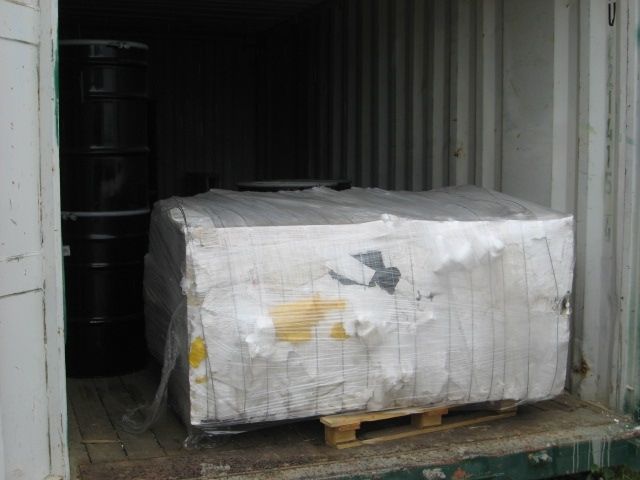 Baled styrofoamSaturday and Sunday, Jan. 12 and 13, the Master Gardeners unloaded vehicles and collected Styrofoam from holiday gifts. Once collected, that foam will be compacted, baled and transported for recycling.
Started in honor of Earth Day 2007, the Master Gardener Save Our Styrofoam (SOS) project has received collaborative support from local waste haulers and county government agencies. Waste Management Inc. (WMI) donates 20-foot roll-off bins to hold the collected Styrofoam. WMI then compacts and bales the foam. Tuolumne County's Solid Waste Division arranges with the county's e-waste hauler to pick up and deliver the Styrofoam bales. A Lodi, Calif., division of Dart Container Corporation repurposes the recycled Styrofoam into food containers.
Styrofoam collection events have been held at the California State Fair and by various other recycling groups. The hope is that, eventually, with California's focus on recycling, Styrofoam will no longer be a product created from fossil fuels that is then eliminated by being buried in the earth.
 In California, the adage goes, "Whiskey's for drinking and water's for fighting." Often that goes for the coastal oceans, as well as inland waterways. But not always. Lori Abbot reports on a current cooperative effort.
At right: Volunteer recreational angler Ken Yuen and CCFRP scientist Jahnava Duryea collecting data on nearshore fishes at Half Moon Bay. Credit: California Collaborative Fisheries Research Program.
 The popular holiday song counts swans, geese, French hens, Turtle Doves and, of course, that partridge. Meanwhile, birders across California are out in the wild, counting everything they see flying past. Lori Abbot has more.
The peregrine falcon was once on the federal list of endangered and threatened species, but was removed in 1999. Photo Credit: UC-Santa Cruz
 Sonoma County Regional Parks has received $1 million from the California River Parkways Program to help purchase 297 acres in the Mark West Creek watershed for a future regional park and open space preserve. The grant is among 33 statewide announced this week by the California Natural Resources Agency.
The award will be used on the second phase of acquisitions for the 1,100-acre Mark West Regional Park and Open Space Preserve envisioned for northeast Santa Rosa. The proposed park and preserve off of Porter Creek Road will link a stunning landscape of grasslands, woodlands, ridgelines, and creeks that flow to the Russian River and are home to steelhead trout and coho salmon.
 The properties feature 20 miles of developed trails for hikers, cyclists and equestrians leading to dramatic views of the Mayacamas and the Santa Rosa Plain and offer a unique nature experience only 15 minutes from downtown Santa Rosa.
"The Mark West properties have all the features of a perfect park and great ecological value for the region," said Regional Parks Director Caryl Hart. "We've been working on acquiring the land for some time, and the grant brings us one step closer to sharing this site with the public."
The Sonoma Land Trust, the Sonoma County Agricultural Preservation and Open Space District, and Regional Parks entered into an agreement last year to acquire and seek funding for the proposed parkland. The Land Trust is collaborating with Regional Parks to secure the approximately $8 million needed for the purchase while the Open Space District is leading negotiations for the acquisitions.
 The grant will be used to complete the purchase of 275.5 acres of the McCullough ranch and 21.5 acres of the adjacent Cresta ranch, with the goal of finalizing the deal by the end of next year. The Open Space District acquired 340 acres of the Cresta property in 2007 and 461 acres of the McCullough property in 2009 for a total of $14 million. The ranches border protected lands to the north, and their acquisition would create a contiguous 4,500-acre wildlife corridor linking the Mayacamas to Mark West Creek and its tributaries.
Sonoma County representatives accepted the River Parkways grant at a ceremony in Sacramento on Wednesday. The grants are awarded to public agencies and nonprofits to acquire, restore, protect, and develop areas along rivers, streams and creeks and to improve public access. The grants are funded by Proposition 84, the water quality bond act California voters approved in 2006.
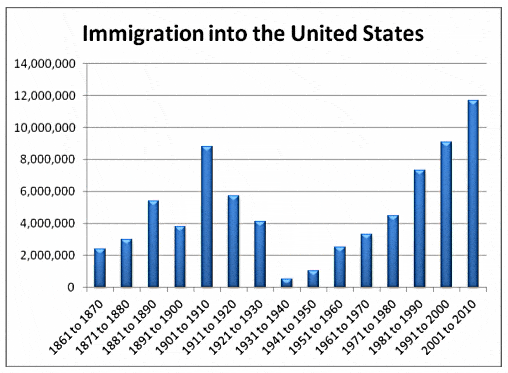 How many more residents can the environment of United States support? That question hasn't been comprehensively studied, but there's a group that says that it should be.
 Phil CafaroThe idea of a national study of the environmental impacts of population growth through immigration is not new, notes Phil Cafaro, president of Progressives for Immigration Reform and a Philosophy professor at Colorado State University. He's hoping that it's time is finally arriving.
It should be noted that there are those, including some respected civil rights organizations, who skeptically view Cafaro's organization as a front for deceptive political efforts to "greenwash" immigration politics.
The graph on the left, prepared by Cafaro, shows projected US population gains through the end of this century under four quite different immigration ceilings.
The two components of population growth are immigration and fertility, Cafaro, says, and in the United States' recent past, the two have been compounding.
