
 Live Radio
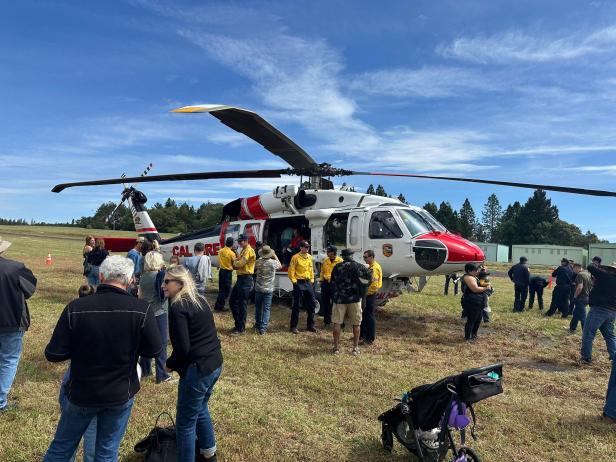 photo credit: Cal Fire Lake-Sonoma-Napa Unit
A Cal Fire specialized helicopter on display in Napa County on Sunday, 20 April, 2026.
North Bay state senator Mike McGuire recently organized a virtual town hall to talk about wildfire and this year's fire forecast.
His guests: three key local fire chiefs.
Each answered questions from the public, outlined how the addition of night-flying firefighting aircraft to their permanent arsenal has made all the difference, and reflected on previous fire experiences.
The 2015 Valley Fire and 2017 Tubbs Fire that ravaged Lake and Sonoma counties spurred major changes to California's wildfire preparation.
One of the greatest impacts has been the push to use controlled fire as a tool for fire suppression.
CAL FIRE Northern Region Chief George Morris said if you were to look at a map of active fires in California at the moment, you'd see quite a few, including in the Northern Coastal region counties like Sonoma, Lake, Napa, Humboldt, and Mendocino.
"We've really reclaimed that prescribed fire mentality, that movement across the state to reduce fuel," Morris said. "It's a cost effective way to do it. It's a great way to keep our skills up for even when we get to the suppression piece. When you couple that with the 699 active grants, grantees that we have across the state implementing fuel reduction projects all across this land, it's incredible to see the work that's going on."
"We've been on pace and have exceeded our goals each of the last three years," Morris said. "This year we're on pace to do the same."
Morris said extensive investments - to the tune of $750 million dollars in grant funds - have gone to forest health, education, and workforce development programs in recent years.
He noted the Alert California public safety camera network has gotten some impactful improvements too.
"We have an AI interface with that now, which is catching about 30% of the time we're dispatching a call to a fire before the first 911 call," Morris said. "That's an incredible jump. It's a light speed advancement in detection, and coming in the next few years will be a low earth orbit constellation of satellites. That's helping us do that even faster."
Morris said Cal Fire has also made major improvements to its aircraft reconnaissance ability, including those stationed in the North Bay.
"We've had two heli-tankers, one at Sonoma Airport, and then one in Napa," Morris said. "They're both night flight capable; so in 2024 on the Point Fire outside of Healdsburg and the Dry Creek area, [was] the first time we flew those at night to great benefit when the humidities recover. We're able to keep that kind of asset on station, where in previous years we had no night flight capability. We have procured seven C-130 large air tankers, and three of them are operational right now, and by the end of the year, the remaining four will be operational. Right now they're stationed at McClellan [Air Tanker Station] and they're ready to respond to a fire right now."
The agency also recently received the final two specialized "Fire Hawk" helicopters.
"Having that capability [with the Fire Hawk's] is something we always dreamed of," Morris said. "When you look at the fires we had in 2017 and 2018, those capabilities did not exist for Cal Fire."
Santa Rosa Fire Department Chief Scott Westrope said another major change since 2017: communication.
"We've broken down a lot of the silos that we saw before, and really when it comes to wildfires, there are no silos," Westrope said. "We're all speaking the same language. We all have the same battle scars, and we communicate and we coordinate throughout the course of the year. To give some examples, proactively within that internal capacity, we have things simply as an operational area call every Tuesday."
"This used to happen on occasion, now it happens 52 weeks out of the year," Westrope said. "Whether the weather's good, bad, or indifferent, everybody's on the same page, from emergency management to the fire districts, fire departments, and police departments. We've looked at funding opportunities across the board. How can we help each other in preparedness, mitigation, prevention, and response?"
Morris said in the Northern Region, Cal Fire hopes to allow landowners to do preventative burning as long as possible, especially with the one-two of a dry winter and late spring rains.
"For the summer outlook...if you're paying attention to the snow pack, which is one of the indicators I look at in the Sierra, the final snow pack survey occurred on April 1st at Phillips Station and it showed that 6% of normal in the Northern Sierra and Southern cascade," Morris said. "A snow pack is kind of our locked away reservoir. That's an indicator that we're going to get fires at high elevation sooner than we would normally."
"That will impact the federal agencies who have jurisdiction in those areas, and that will impact mutual aid response potentially at the same time that we're having fires in the front country or in the Bay area," Morris said. "We're seeing an incredible amount of growth in our grasslands. This late rain means that we'll get secondary and tertiary growth in the grasslands. I think that can be the fuse for a bomb that could be a very difficult fire season. I think it's just an indicator of something that can mean we're going to be quite busy."
California is still working on a final set of defensible space regulations - including the Zone 0 - that's the five feet immediately around a structure, but both Morris and Lake County Fire Protection District Chief Willie Sapeta said there's plenty homeowners can, and should do now.
"In general, the idea is remove things that can burn," Morris said about Zone 0 defensible space. "So think about wood piles that you may have against your home. You already need to have that cleared out of there for defensible space anyway. If you have junipers or volatile vegetation right next to your structure, that's something that's probably going to have to be removed."
"I'm removing anything that isn't well watered," Morris said. "Anything that can combust, construction materials, anything that you leave around your home, just imagine when wind hits your home and leaves collect, that's where embers are going to show up. So finding those areas as you notice the wind blow around your home, where things collect, keep those areas clean."
"We'd really like to see that minimum 30 foot, and then of course that 100 foot [defensible space]," Lake County Fire Protection District Chief Willie Sapeta said. "Like Chief Morris was talking about, a lot of that juniper and stuff is highly flammable. It's got a lot of oils to it. So even if you cut those down or cut them back, they're still going to be a potential threat."
"Then looking at the ladder fuels; get the grasses cut, get the trees, what we call lollipop-ed about 10 foot off the ground, and eliminate that ground fuel going up into the ladder fuels, into the bigger fuels," Sapeta said. "But I would prefer to see that type of vegetation a hundred foot away from the structure for all safety purposes."
You can watch a recording of the April 15th town hall on California Senate Democrats YouTube page.

 NPR
NPR Spotify