 Live Radio
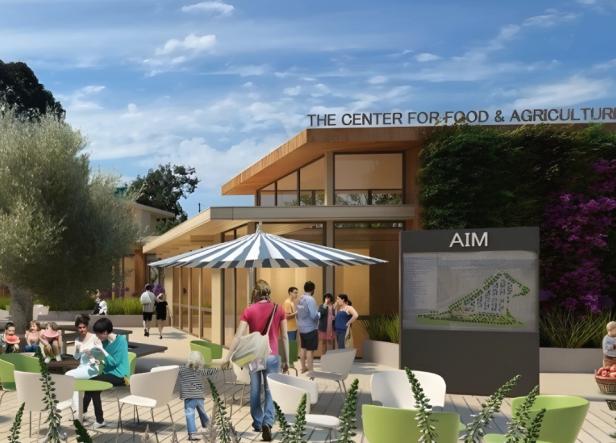 photo credit: AIM
An artist rendering of what the new permanent farmer's market at Marin Civic Center may look like.
The Agricultural Institute of Marin---known by the acronym AIM--- is building a new innovative permanent home for the Marin Farmer's Market. KRCB's Greta Mart speaks with AIM's chief executive to learn more about the project.
ANDY NAJA-RIESE: I'm Andy Naja-Reise. I'm the Chief Executive Officer of the Agricultural Institute of Marin.
KRCB NEWS: Will you just tell us briefly, what is the Agricultural Institute of Marin?
NAJA-RIESE: The Ag Institute of Marin, or AIM, is a 501c3 nonprofit organization that works to create a healthier, more equitable, earth-friendly, local and regional food and agricultural system. We're headquartered in Marin County in San Rafael, and we operate farmer's markets, food access, education, and training programs across the Bay Area.
KRCB NEWS: Just give me examples of some of the farmer's markets that you run that people would be familiar with.
NAJA-RIESE: We're known for our farmer's markets, including our flagship market in San Rafael at the Marin County Civic Center that operates on Thursdays and Sundays. We also are known for our farmer's markets in San Francisco, at Clement Street in the Richmond District and Stonestown, as well as our markets in the East Bay—Grand Lake, that's located at Lake Merritt, downtown Hayward and Newark at New Park Mall. We think about our food system from a regional perspective, and we've created partnerships with different cities and counties and local organizations to operate markets across the Bay Area. And today we have nine certified farmer's markets. Seven of those are year-round, two are seasonal. And then we also have a mobile farmer's market called the Rollin’ Root that brings fresh, local, affordable produce and dairy products to communities with limited food access.
KRCB NEWS: There’s this new thing called the Center for Food and Agriculture. Can you just tell me everything about it?
NAJA-RIESE: Sure, I have a lot to say about it. So the Center for Food and Agriculture is really the next iteration of farmers' markets and local food. In September of 2025, AIM signed a 40-year lease agreement with the County of Marin that allows us to move forward with building a permanent farmer's market, along with a food innovation hub, that will focus on agricultural education, training and resource development for farmers and food makers, and a place for the community to gather to enjoy local food and community connection.
KRCB NEWS: And where will this be?
NAJA-RIESE: It will be located at the Marin County Civic Center in San Rafael. Currently it's a dirt lot, it's actually a parking lot where people park to attend our current Thursday Civic Center Farmer's Market. It was previously known as the Christmas Tree Lot, and now that we've signed the lease agreement, it will become our new home for our permanent farmer's market, as well as the Food Innovation hub that we're building. And the Civic Center is actually designed by Frank Lloyd Wright, so everything we're doing actually aligns with design principles from Frank Lloyd Wright. We had to present our design concepts to the Frank Lloyd Wright Conservancy. So it's not only a wonderful place to support local food and farmers, but it's also reflecting the architectural traditions of Frank Lloyd Wright as well.
KRCB NEWS: I didn't know you had to submit your plans to that body.
NAJA-RIESE: Yes. There's lots of planning, lots of stakeholders and so not only the County of Marin, our partners there, but as well as the farmers and food makers, chefs, people who shop the market, the Frank Lloyd Wright Conservancy. And then we also went through as part of the state rules for environmental studies; we went through the environmental study process and completed that as well.
KRCB NEWS: Okay. So you've gone through all the red tape and…have you selected the builder? What's this site actually going to look like?
NAJA-RIESE: We are at the point of finishing our permits with the County of Marin. So we're working with the Department of Public Works and once we complete our permits, then we're actually going to go out to bid to hire a builder. But the way the site's going to look, it's a little shy of four acres and the majority of the site will be turned into the permanent farmer's market and permanent in the sense that it's our space. Usually farmer's markets are in empty parking lots or enclosed streets, but this is our dedicated space where we can actually build infrastructure and amenities. So that will include overhead canopies that will provide shading in the summer and rain protection in the winter, as well as permanent restrooms, drinking water stations, electrical plugins for producers, so they won't have to bring gas generators to cook food on site, they can plug in—as well as wifi, lots of trees, permanent seeding and shading. Most of the site will be a beautifully-designed, environmentally sustainable farmer's market. We currently run the markets on Thursday and Sunday at the Marin Civic Center, and eventually we'll add a Tuesday market. The second part of the site is our phase that we call the Food Innovation Hub. And the food innovation hub will have a central plaza for a community gathering and special events related to food, it actually consists of three different buildings. It's about 6,600 square feet. And these buildings will encompass a range of our facilities for programming. So a kitchen space for demonstrations, it will also have classrooms for agricultural education as well as workshop space. We'll have a visitor center with a cafe and office space, and then a whole outdoor learning center that will include an outdoor classroom climate resiliency gardens to teach about soil health and organic and regenerative agriculture, a children's learning garden to teach children how to grow food as well as a greenhouse and other educational experiences.
NAJA-RIESE: The buildings reflect the design principles of Franklin Lloyd. So what we're doing that's sort of innovative, we're working with a private home developer, they're called Lindal Cedar Homes, and they have a partnership with the national Frank Lloyd Wright Conservancy. And they've created a line of homes, they're called Usonian Homes. So these are very organic-style architecture, very open space, and we're going to turn those homes into the spaces that we'll have for our kitchen classrooms, cafe and visitor center. They're all modular. So we get these kits, and then we're working with a local architect who'll actually do the interior design. So it's modified from a home into functional space, but the buildings will come in phase two. So what we're focused on right now is phase one, which is the permanent farmer's market.
KRCB NEWS: It sounds pretty ambitious. You’ve got all the funding and everything for this?
ANDY NAJA-RIESE: So we are currently fundraising and we've, to date, we've raised about 7.4 million, and that's through a mix of funding, largely private funding. We are a private nonprofit, so we're not government, so we are doing private fundraising and we're continuing to fundraise so we can complete the balance of phase one. And that includes, we have a capital campaign.
KRCB NEWS: How did you make this whole thing happen? It sounds pretty amazing.
ANDY NAJA-RIESE: We're pretty lucky to live in a place like the Bay Area, where we have so much local food and we have access to delicious food. But a lot of what we do is at risk as the climate's changing. We're seeing rates of hunger increasing. It's challenging for farmers and food makers, especially small organic farms, to remain competitive just as the cost of doing business continues to rise. So we felt that it was important to think about ways that we can solve these problems. And we know farmers' markets are very popular, but we know that farmers' markets have thrived on this sort of temporary popup type nature, and it's time to put down our roots and make things permanent. A lot of the legwork had been underway. There was always this concept of, to create a permanent type of farmer's market at the Marin County Civic Center. Marin has been a leader in local food, and especially organic agriculture. And in 2014, there was actually a ballot measure. So prior to my arrival, there was a ballot measure that 83% of the voters approved in order to construct a permanent farmer's market at the Marin County Civic Center.
KRCB NEWS: So you get funding from that? Is it a sales tax?
ANDY NAJA-RIESE: No, there's no funding. It wasn't a bond, it was a ballot measure. So there's still some confusion when people say, ‘oh, well, we voted for that.’ It's like, yes, you did, you approved the construction, but without any money associated with it for building the farmer's market. But there's actually an interesting history in Marin County where the county jail is built into the hillside at the Marin County Civic Center. And after that happened, there was some strong community response. This was many decades ago, and there's an ordinance in Marin County that any construction greater than 250 square feet at the Marin County Civic Center requires a voter-approved ballot measure.
KRCB NEWS: I did not know that.
ANDY NAJA-RIESE: Our markets are a destination, especially for farmers and food makers. So we have farmers and food makers that sell at our markets from over 40 of the 58 California counties. And there, there's just as many farmers from Sonoma County and the Central Valley as we do in Marin County, if not more, selling at our farmer's market. And we also provide a destination for local residents to buy their groceries. People who are visiting to, uh, experience year round, seasonal farmer's markets, as well as chefs.
KRCB NEWS: Just for right now, what do you want folks to know?
ANDY NAJA-RIESE: I want people to understand that what we're doing is important to make sure that all people are able to access foods. And one of the ways that we do that is through a program called Market Match.
KRCB NEWS: That's still being funded? That's still totally available?
ANDY NAJA-RIESE: Well, it has been funded, but we're at a point where we're gonna run out of funds in early 2027. The last time there was a state appropriation for this program was in 2024. It was $35 million for the entire state of California. And we are projected to run out of funds in early 2027, January or February. Right now we're working through a coalition and working with our local assembly member, Damon Connolly, who represents Marin and Southern Sonoma counties to request additional state funding so we can continue the program because it's not only a safety net for people on limited incomes, but it's also a very strong source of revenue for our farmers and food makers.

 NPR
NPR Spotify